There are over 100 million songs in the world, yet the true number is impossible to pin down. Every day, new music is being made, and countless tracks remain unlisted publicly.
This immense and ever-growing collection highlights just how alive music truly is. Each day, tens of thousands of songs are added, keeping the world’s library of music fresh, endless, and full of surprises for listeners everywhere.
How Many Songs Are Released Every Year and Every Day?
In 2025, around 106,000 new songs were uploaded to streaming services every single day. This means music is being created and shared at an incredible pace, from big artists to independent creators, constantly expanding the global music library.
When you look at it across a whole year, that adds up to roughly 38.6 million new tracks. Every month, listeners get millions of fresh songs, showing just how alive and unstoppable the world of music creation has become.
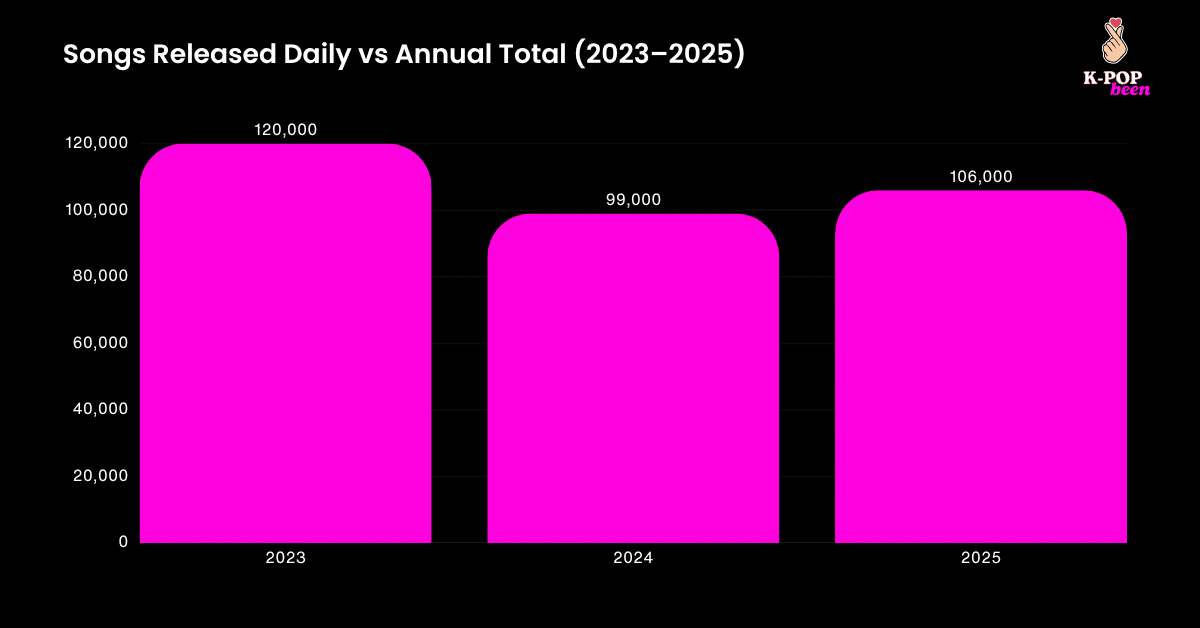
Here’s a simple view of the daily and yearly release pace in recent years:
| Year | Avg. Songs Released Daily | Estimated Annual Total |
|---|---|---|
| 2023 | 120,000 | 37.8 M |
| 2024 | 99,000 | 36.1 M |
| 2025 | 106,000 | 38.6 M |
Source: Music Business Worldwide, Luminate Report
The First Song Ever Created
The earliest known written melody is the Hurrian Hymn (No. 6), dating to around 1400 BCE. Found on clay tablets in ancient Mesopotamia, it preserves one of the oldest examples of musical notation, although parts of the melody are missing or reconstructed.
Source: My Modern Met
The oldest complete playable song is the Seikilos Epitaph, dating to around the 1st–2nd century CE. Engraved on a tombstone in ancient Greece, it includes full lyrics and musical notation, allowing us to hear a composition created nearly 2,000 years ago.
Source: Guinness World Records
Which Language Has the Most Songs Globally?
English dominates the global music scene, making up over 50% of the top streaming tracks. Its global reach keeps it at the center of music creation and listening.
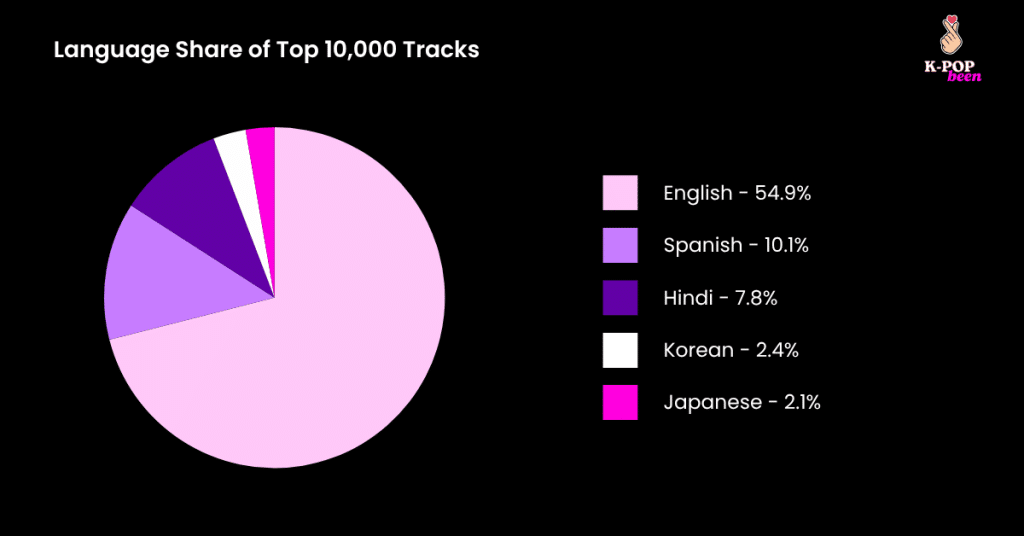
Spanish, Hindi, Korean, and Japanese follow closely, showing how listeners are exploring music in many languages.
| Language | Share of Top 10,000 Tracks |
|---|---|
| English | 54.9% |
| Spanish | 10.1% |
| Hindi | 7.8% |
| Korean | 2.4% |
| Japanese | 2.1% |
Source: Music Business Worldwide, Luminate
Artists With the Most Songs Released
P. Susheela holds the Guinness World Record for the most songs recorded by a female singer, with over 17,000 songs. Her voice defined generations.
Source: Guinness World Records
Asha Bhosle holds the record for the most studio recordings, having recorded around 11,000 songs across multiple languages, which highlights her extraordinary versatility.
Source: Guinness World Records
For male singers, SP Balasubrahmanyam is estimated to have sung over 40,000 songs, possibly making him the male artist with the highest recorded tracks in history.
Source: Wikipedia
How Many K-Pop Songs Are There?
It is difficult to determine the exact number of K‑Pop songs. However, the Korea Music Copyright Association (KOMCA) manages over 8.4 million registered works, including trot, indie, and international songs.
Because this total includes many genres, it does not represent only K-Pop songs, but it highlights the massive scale of music connected to Korea’s industry.
Source: KOMCA
Korea is the fourth-largest country contributing to global music, and new K‑Pop songs are released daily, growing this ever-expanding genre.
Source: Music Business Worldwide, Luminate
How Many K-Pop Songs Are Released Every Year and Every Day?
South Korea releases 35,000 songs annually. In 2026, BTS returned with ARIRANG, shattering records and topping global charts.
Major groups lead 120+ annual comebacks. This surge is driven by legends returning from military service to compete globally.
Daily registrations average 80–100 tracks, peaking on Mondays and Fridays. This strategy maximizes both domestic rankings and Billboard impact.
Physical sales surpassed 100 million in 2026. High-fidelity collectible albums remain the primary driver for massive industry growth.
Source: Circle Chart, IFPI, Luminate
K-pop Idol with the Most Songs
In K‑pop, the number of songs an artist has is often counted by how many works they’ve officially registered with the Korea Music Copyright Association (KOMCA). This shows not just what they sing, but what they helped create.
As of 2023, Ravi (former VIXX member) leads the list with 238 registered songs, making him the K‑pop artist who has officially written or composed the most music.
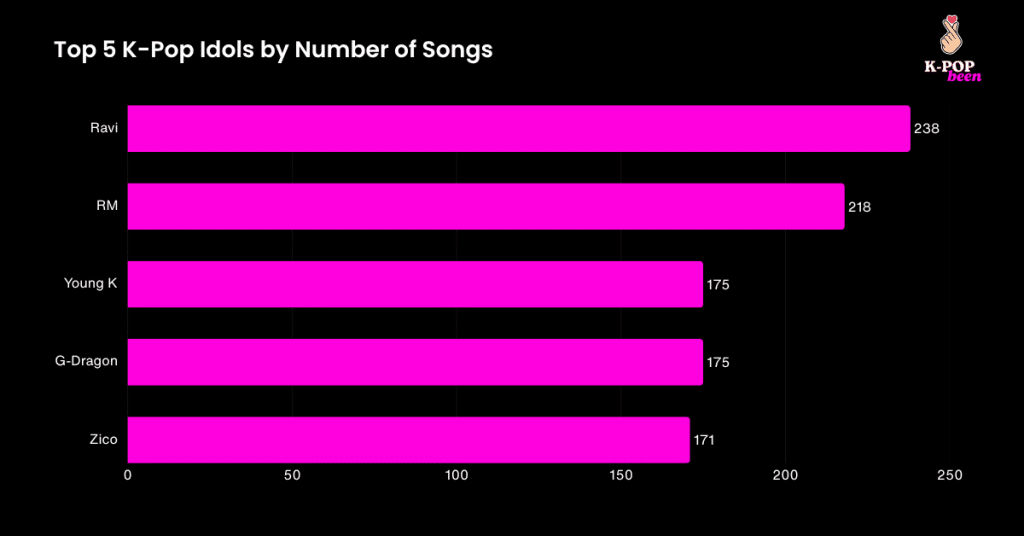
Here are the top 5 K‑pop artists with the most songs registered on KOMCA (2023):
| Rank | Idol | Group (if any) | Number of Songs |
|---|---|---|---|
| 1 | Ravi | VIXX (former) | 238 |
| 2 | RM | BTS | 218 |
| 3 | Young K | DAY6 | 175 |
| 4 | G‑Dragon | BIGBANG | 175 |
| 5 | Zico | Block B | 171 |
Source: Pinkvilla
Some Interesting Stats About Songs
From timeless classics to modern chart-toppers, here are some fascinating stats that show just how extraordinary songs can be:
1. The Best‑Selling Physical Single of All Time
The best-selling physical single of all time is “White Christmas” by Bing Crosby, with over 50 million copies sold worldwide. Even after so many decades have passed, this song still resonates with people.
Source: Guinness World Records
2. The Most Streamed Song
On Spotify, “Blinding Lights” by The Weeknd has become the most-streamed song ever, with over 5.36 billion plays. Fans keep returning to its catchy beat and unforgettable hook.
Source: Spotify, ChartMasters
3. The Most Viewed Music Video
The most viewed video on YouTube is “Baby Shark Dance” by Pinkfong, with over 16.3 billion views. What started as a children’s song became a global cultural phenomenon.
Source: YouTube
The Future of Music Worldwide
Music will grow bigger, faster, and more global, offering more songs, generating more revenue, and creating entirely new ways for artists and fans to connect.
- The Numbers: How Many Songs Will Be Released?
By 2030, artists worldwide could release over 100 million songs annually. With AI tools, affordable production, and streaming platforms, artists can now create and share music more easily than ever before. - The Financial Future: Revenue Forecasts
This explosion in music creation comes with growth in money: global revenues may surpass $150 billion by 2030, driven by streaming and rapid expansion in markets like India and Africa.
Three Key Trends Defining the Future
- AI and Generative Music – AI will speed up songwriting and inspire new genres.
- Emerging Market Expansion – India, Brazil, and Nigeria will shape the global music scene.
- Direct-to-Fan Monetization – Artists will earn through subscriptions, virtual concerts, and fan platforms, reducing dependence on traditional labels.
Ultimately, over the next decade, music will not only grow in size but also become faster, smarter, and more personal, connecting fans and creators worldwide like never before.
Source: Goldman Sachs, MIDia, Grand View Research
Conclusion: Over 100 Million Songs Exist Worldwide
The world currently holds over 100 million songs, and new music continues to flood in every day, keeping listeners engaged globally.
Moreover, as artists release around 106,000 new tracks daily, the global music library expands rapidly, providing fresh and diverse content for fans worldwide.
Looking ahead, by 2030, they could release over 100 million new songs annually, highlighting that music creation will grow faster than ever before.
FAQs
Over 100 million songs exist worldwide, and with new tracks uploaded daily, music continues to grow into an endless, ever-evolving library.
SP Balasubrahmanyam likely holds the record, having sung over 40,000 tracks across multiple languages throughout his prolific career.
South Korea releases roughly 35,000 songs per year, with K‑Pop dominating daily charts and driving global music trends.
BTS’s “ARIRANG” topped global charts, achieving high streams and sales, marking their strong comeback after members’ military service.
English dominates globally, making up over 50% of top tracks, while Spanish, Hindi, Korean, and Japanese also hold significant positions.