
You may have scrolled through YouTube lately and come across K-pop idols dominating your feed? Meanwhile, J-pop stays quietly powerful in Japan, adored by millions but rarely making waves outside.
The language alone doesn’t explain it. Well, the truth lies deeper, in how these industries train artists, build fan loyalty, and measure what success actually means.
In this article, I’m going to break down the real reasons behind their separate journeys. You’ll know why Korean entertainment is chasing worldwide fame while Japanese music perfects what works at home.
K-pop vs J-pop: Key Differences At A Glance
Korean pop is basically a military-grade export machine. Japanese pop, on the other hand, feels more like your neighborhood’s favorite band that never needed to leave town. Both succeed wildly, just with completely opposite goals.
| Aspect | K-pop | J-pop |
|---|---|---|
| Global Reach | Worldwide phenomenon | Primarily domestic focus |
| Training System | 2-7 years rigorous training | Growth alongside fans |
| Musical Style | Genre fusion (EDM, hip-hop, R&B) | Melody-driven, diverse subgenres |
| Marketing | Multi-platform, subtitles, global tours | Domestic TV, anime tie-ins |
| Industry Model | Centralized (Big 4: HYBE, SM, YG, JYP) | Decentralized agencies |
The different paths are due to the Economic pressure, cultural philosophy, and strategic timing, all of which played their part. Let me walk you through what really happened.
Why Is K-pop More Popular Than J-pop?
Korean pop didn’t stumble into worldwide fame. The country engineered it deliberately, almost like launching a national tech startup. Two major forces made this possible.
The Hallyu Wave Strategy
The government created the Korea Creative Content Agency and started funding entertainment like infrastructure. Entertainment companies realized that they couldn’t survive on Korea’s small population alone.

So they built global thinking into every decision from the start. English subtitles became standard. Staff learned multiple languages. Even the choreography was designed to communicate emotion without a single word spoken.
Perfection-Driven Training
A fourteen-year-old joins as a trainee and spends the next several years doing daily dance rehearsals until they can mirror each other’s movements down to the millisecond. Vocal coaches dissect every note.
Language like Japanese, English, and sometimes Mandarin is taught. Media trainers teach them how to smile for cameras and answer interview questions without stumbling. Some people train for seven whole years before their debut gets approved.
Why J-pop Stays Rooted In Japan?
Here’s what surprises most people: Japan easily could have copied Korea’s strategy. They just chose not to. Why? Because they already have something Korea desperately needed, a massive, wealthy audience right at home.
The Domestic Market Advantage
Japan operates the world’s second-biggest music market. The CDs are still present in Tokyo record stores. Young Japanese fans still collect physical albums because they come with exclusive photo cards, lyric booklets, and sometimes handwritten notes from idols.

Then there are handshake events. Fans literally stand in line for hours to shake hands and chat briefly with their favorite members. AKB48 turned this into a billion-dollar business model. So they are basically making their money at home.
Diversity Over Uniformity
Artists like Yoasobi and Ado shattered Spotify Japan records in 2025 by sticking to their weird, wonderful sounds instead of smoothing out their edges for global appeal. What’s really interesting is how Japanese fans embrace imperfection.
They watch idols stumble through early performances, improve gradually, and become better over months and years. An idol who messes up choreography but keeps trying? Fans love that person more than someone who debuts already perfect. It’s about shared growth, not polished products.
K-pop vs J-pop Popularity: Global Numbers Explained
Comparing these two industries is like comparing a marathon runner to a weightlifter. Both are impressive athletes, but you can’t use the same scorecard for both.
| Aspect | K-pop | J-pop |
|---|---|---|
| Market Focus | Global streaming platforms | Domestic physical + growing digital |
| 2024 Physical Sales | Declining but strong | The top physical market globally |
| Top Streaming Artist | BTS Jungkook: 300 million streams | Number_i: 1.4 million monthly listeners on Spotify |
| Digital Growth | Platform-first strategy | Gradual streaming adoption |
Korean pop tops the streaming and social media metrics. And Japanese pop owns the physical sales game in Japan. Both of these are playing different games, thereby maintaining their individuality.
K-pop vs J-pop Idols: Training and Lifestyle Differences
Becoming an idol differs sharply by country. In Korea, teens enter intense training for years in dance, vocals, languages, and media skills, under strict rules and constant supervision, aiming for international perfection.
In Japan, idols start young, grow publicly on TV, show their real personalities, and pursue side interests. Fans value relatability over flawlessness, making them feel approachable and authentic.
J-pop vs K-pop Music Style & Performance Differences
K-pop shows are flashy, with every member perfectly in sync and videos full of big sets and costumes. J-pop focuses more on tunes that you can’t forget, and letting each singer’s voice shine, often on TV shows rather than huge concerts.
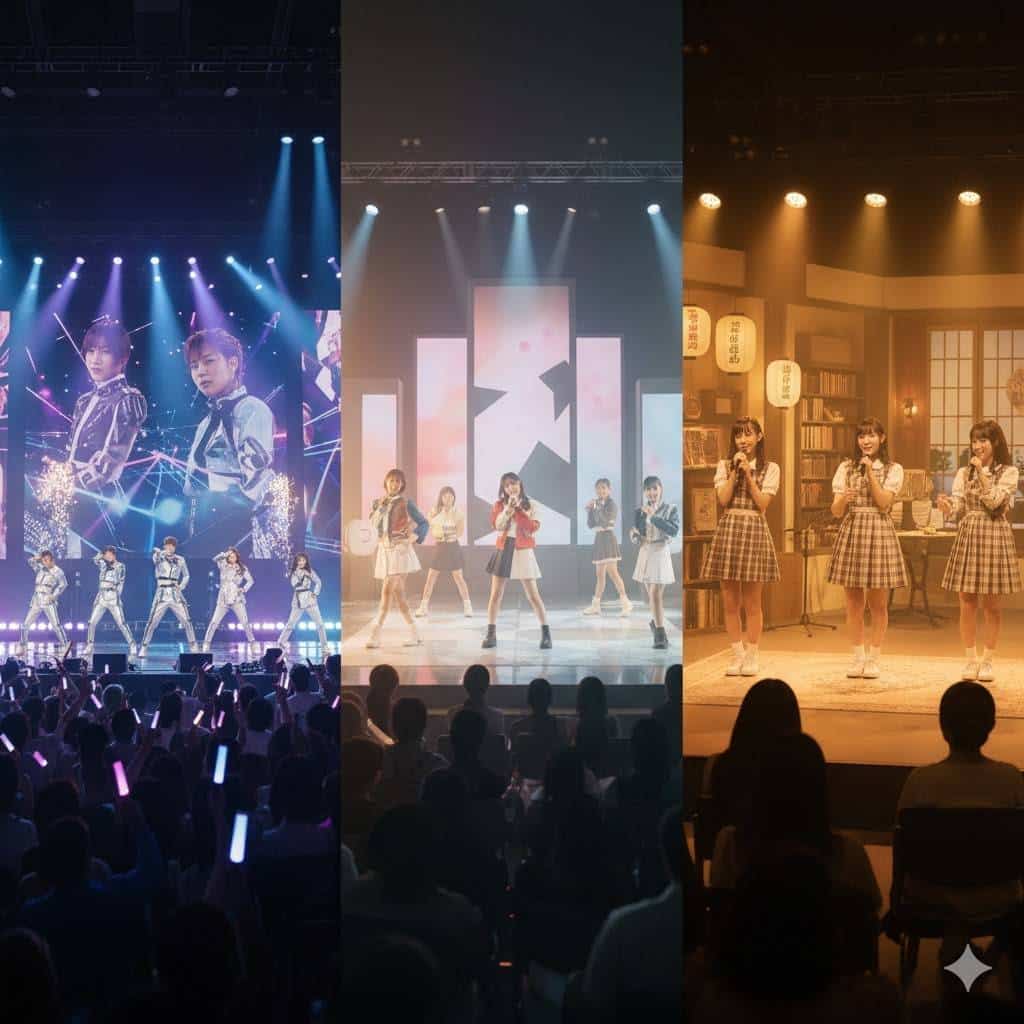
Lately, groups like NiziU are mixing both styles, blending Korean training with Japanese appeal, to create music that looks great, sounds memorable, and connects with fans at home and abroad.
Related Reads:
Conclusion: K-Pop Dominates Globally; J-Pop Remains Deeply Rooted In Japan
Looking at K-pop and J-pop side by side, it’s clear they play different games. K-pop focuses on global reach, with government support, long training, and polished digital content.
J-pop thrives at home, using Japan’s strong market, diverse music, and personal fan connections. Neither is better; they succeed in their own ways. One leads in international tours and streaming, the other in physical sales and local impact.
Both keep changing but stay true to their style. It depends on whether you prefer a worldwide spectacle or a local charm.
FAQs
Korean pop excels at delivering globally polished entertainment, while Japanese pop offers genuine musical diversity and authentic fan intimacy; they’re designed for different audiences.
J-pop dominates the local market with physical sales. And K-pop reaches more people through global streaming and tours.
K-pop grew worldwide through government support, long idol training, multilingual content, and social media use. At the same time, Japan stayed focused on its domestic audience.
Both use idol groups, choreographed performances, visuals, and have strong fan communities. Collaborations like NiziU show that their styles can mix.
Yoasobi, Ado, Number_i, Nogizaka46, and Mrs. GREEN APPLE dominate charts and maintain strong physical and streaming sales in Japan.